Key Takeaways
- Breathing techniques are commonly used for relaxation: Different breathing patterns are often incorporated into stress-management and mindfulness routines.
- Breathwork may influence mood and stress response: Controlled breathing is associated with calming the nervous system and promoting relaxation.
- Different techniques serve different purposes: Methods like box breathing, alternate nostril breathing and diaphragmatic breathing vary in pace and focus.
- Consistency is often emphasized: Regular practice is commonly recommended when incorporating breathing exercises into a wellness routine.
- Breathing exercises can be done almost anywhere: Most techniques require no equipment and can be practiced at home, work or while traveling.
Feeling a little low?
A natural and easy way to lift your mood is to focus on breathing. Two techniques in particular can make you feel better quickly.
Many studies show that breath-work calms the nervous system and can help treat mild forms of depression. Yogic breathing helps with relaxation and managing stress, so it’s no surprise it can be an antidote for grouchiness.
Mood-Boosting Breathing Techniques
Three-part breath
Diaphragmatic breathing has been shown to relieve emotional exhaustion, among other benefits. A study published last year in Frontiers in Psychology also suggests it has mental-health benefits. It’s your body’s natural way to breathe but often gets stamped out by stressed-out chest breathing. The three-part breath capitalizes on the diaphragmatic style by incorporating the full capacity of your lungs, helping you inhale and exhale even more completely and slowly.
How to do it:
Lying down, seated or standing. Lying down is most comfortable and the easiest method for newcomers to breath-work.
- Lie comfortably on your back, and place both hands on your belly so that the tips of your middle fingers touch.
- Inhale as you lift and press your belly into your hands. Do so until your fingers move away from each other and no longer touch. Exhale, feeling your belly fall and your fingers touch again. Repeat this another time or two.
- Move your hands so that they cup your outer ribs (to be sure, your fingers will no longer touch). As you did moments ago, inhale, pressing your belly up. Then take another sip of air drawing it to your middle torso and pressing your rib cage into your hands. Exhale, feeling your ribs move back to neutral and your belly fall. Repeat this another time or two.
- Place your hands on your chest. As you did moments ago, inhale pressing your belly up, and then expand through your ribs. Now take yet another sip of air, drawing it toward your chest so that it rises beneath your hands. Exhale, feeling your chest fall, ribs move back to neutral and your belly deflate (these actions don’t have to happen in a specific order).
- Continue to breathe as you did in step 4, but feel free to move your hands to any part of your torso in any combination. Take at least another 10 breaths this way—more if you want
Alternate nostril breathing (simple version of anuloma valoma)
It’s near impossible to rush this breathing exercise because when you inhale or exhale via a single nostril you have to do it for longer than you would using both nostrils. That means you’re forced to breathe smoothly. You’re also forced into diaphragmatic breathing in order to get full breaths.
How to do it:
Seated is best. You can stand or lie down, but either might feel awkward.
- Sit comfortably, and rest your left hand in your lap.
- Place your right thumb against your right nostril, bending your pointer and middle fingers (to get them out of the way) as you extend your ring and pinky fingers so that your ring finger is near the outside of your left nostril.
- Use your thumb to seal your right nostril, and then exhale completely through your left nostril.
- Inhale a moderate breath through your left nostril, and then use your ring finger to seal it off. With both nostrils sealed, hold your breath for few counts.
- Release your right nostril and exhale completely through it.
- Inhale a moderate breath through your right nostril, and then use your thumb to seal it off again. With both nostrils sealed, hold your breath for a few counts.
- Release your left nostril and exhale completely through it. Go to step 4, and repeat the process for at least 5 more breath cycles—more if you want.
After each exercise
Sit for at least a minute or so, and notice how you feel. You might sense a light, buzzing sensation in your head, or your fingers might tingle. This is a form of the “yoga high,” which owes pretty much everything to the slow and intentional cadence of inhales and exhales you followed.
References:
- Ma, X., Yue, Z.-Q., Gong, B.-Q., Zhang, H., Duan, N.-Y., Shi, Y.-T., Wei, G.-X., & Li, Y.-F. (2017). The effect of diaphragmatic breathing on attention, negative affect and stress in healthy adults. Frontiers in Psychology, 8, Article 874. https://doi.org/10.3389/fpsyg.2017.00874 Cited by: 954
- Mehta, P., & Sharma, M. (2010). Yoga as a complementary therapy for clinical depression. Complementary Health Practice Review, 15(3), 156–170. https://doi.org/10.1177/1533210110387405 Cited by: 9
DISCLAIMER:
These statements have not been approved by the Food and Drug Administration. These products are not intended to diagnose, treat, cure, or prevent disease.
























































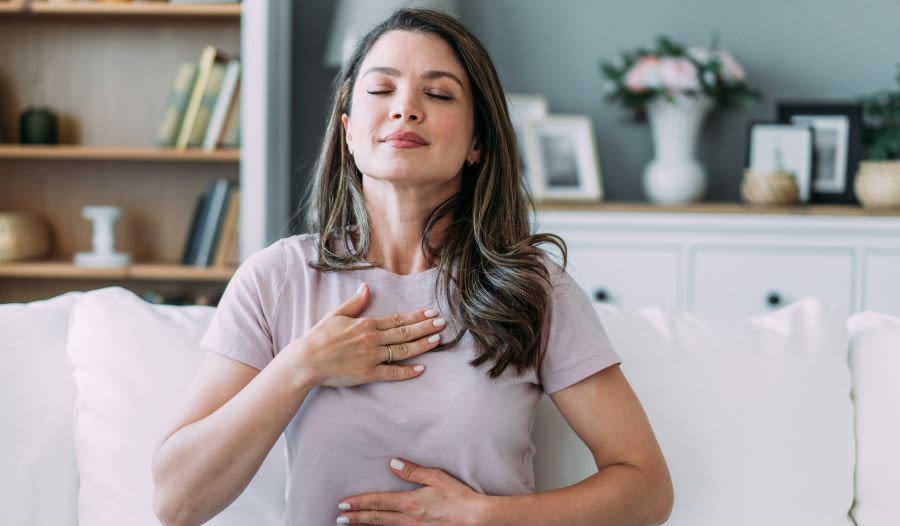
 Table of Contents