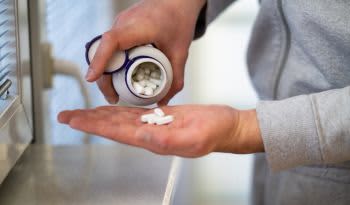
Monolaurin is a compound your body can make from lauric acid, the main fatty acid in coconut oil, and it's sold as a dietary supplement marketed for immune support. But human studies have not established this benefit. Here is what we know, what remains uncertain, and how to choose a quality supplement.1
Key Takeaways
- Monolaurin, also called glycerol monolaurate, is derived from lauric acid, a fatty acid abundant in coconut oil.
- Cell and laboratory studies show its microbial balance effects on certain organisms and their membranes; yet these results do not establish benefits from oral supplementation in humans without clinical evidence.1
- As of late 2026, there is no clinical evidence establishing an effective dose or specific health benefit for oral monolaurin supplements.
- If electing to take an oral monolaurin product, choose one that clearly lists its monolaurin amount, follows good manufacturing practices, and undergoes appropriate independent quality testing.
What Is Monolaurin?
Monolaurin is a monoglyceride made from lauric acid and glycerol. You may also see it called glycerol monolaurate or glyceryl laurate. Lauric acid accounts for a substantial share of coconut oil’s fatty acids, but coconut oil itself is not a measured source of preformed monolaurin; digestion and metabolism may generate some, and the amount produced from a serving has not been established.2
Researchers have also measured glycerol monolaurate in human milk. This is an interesting finding indicating a possible reason or benefit in infants, but the amount naturally present in milk does not establish the benefits or safety of concentrated monolaurin supplements.3
Why Are Researchers Interested?
In laboratory experiments, monolaurin can affect the lipid membranes of some microbes and alter their growth or signaling. This direct physical microbial balance effect is one reason researchers continue to investigate monolaurin. The effects depend on concentration and direct contact with the organism. The effects of monolaurin as a dietary supplement are unknown as there is a big difference in taking it in a capsule compared to an effect on microbes in a laboratory experiment.4–6
Laboratory studies also suggest that glycerol monolaurate may affect signaling in human immune cells. Again, whether taking it orally produces a meaningful effect on normal immune function has not been determined.7
Why Does Human Breast Milk Contain Monolaurin?
Monolaurin is thought to be one contributor to breast milk’s natural defenses. Human milk contains about 3 mg/mL monolaurin. That is a relatively significant amount and roughly 20 times the level measured in the cow’s milk samples. Removing monolaurin and other fat-soluble compounds reduced the milk’s antibacterial activity; adding only monolaurin back restored activity against a tested bacterium.3
The proposed role of monolaurin in human milk is to help limit some unwanted microbes and moderate inflammation at the infant’s gut lining, potentially helping shape a healthy early microbiome. That remains an inference from laboratory experiments: the study did not isolate monolaurin’s full contribution to breast milk or show that giving monolaurin to infants produces those effects.
Does Monolaurin Support a Healthy Microbiome?
In addition to the potential role of monolaurin in breast milk, laboratory work has also suggested that monolaurin may support a healthy microbiome. In a four-month mouse study, dietary monolaurin changed the gut microbiome in a dose-dependent way. Specifically, it increased the abundance of several bacterial groups the researchers considered potentially beneficial.10
These findings provide a reason to investigate monolaurin for microbiome support in humans. But as of 2026 there is no clinical evidence that taking monolaurin orally selectively improves the human gut microbiome.5,8,9
What Human Studies Have Found
Published human research has largely evaluated topical formulations that contact the area being studied directly. For example, a small 2010 study, 36 women self-administered intravaginal gels containing 0%, 0.5%, or 5% monolaurin every 12 hours for 2 days. Vaginal swabs were collected before and immediately after the first gel administration and 12 h after the final gel administration. Swabs were tested for Lactobacillus and undesirable yeast and bacterial strains. Monolaurin had no effect on vaginal pH, but was effective at significantly reducing undesirable flora.8 However, a more recent, larger randomized study of a 5% monolaurin gel versus a placebo in 109 women with vaginal flora imbalance showed no significant improvement in reducing this bacteria despite increasing the Lactobacillus population.9
A review of monolaurin as a dietary supplement found no peer-reviewed clinical evidence establishing therapeutic applications, bioavailability, or an effective oral dose in humans.1
How Much Monolaurin Should You Take?
Monolaurin has no official recommended dose, no established tolerable upper intake level, and no dosing studies in humans. Products vary in the amount supplied per capsule or scoop. If you choose to try one, follow its labeled directions and avoid interpreting high-dose schedules promoted online as clinically validated. An amount used in a topical study cannot be converted into an equivalent oral dose.1
Choosing a Quality Supplement
Look for a label that states the amount of glycerol monolaurate per serving, rather than only a vague “coconut complex.” Pellets, capsules, and powders mainly differ in convenience and serving size; no human study has shown that one form works better than another. Choose a manufacturer that follows dietary supplement good manufacturing practices and can document independent testing of product identity and relevant contaminants.
Is Monolaurin Safe?
In food, glycerol monolaurate falls under the U.S. Food and Drug Administration’s (FDA) generally recognized as safe (GRAS) regulation for mono- and diglycerides. It has been consumed in trace amounts in processed foods for decades, and it occurs naturally in breast milk, which is why researchers consider the compound itself benign at dietary levels.
However, as a dietary supplement levels can be up to 50 times higher than typical dietary exposure, and there is no published human safety data at this level. Reported monolaurin side effects are mostly anecdotal and gastrointestinal: nausea, loose stools, and stomach discomfort, particularly at higher amounts.
A few specific groups should take extra caution:
- People with coconut allergies should check with an allergist, since most commercial monolaurin is coconut-derived, though the final purified compound differs from coconut proteins that trigger most reactions.
- Anyone pregnant or breastfeeding should skip supplement doses entirely, because no safety data exists for those situations.
- People with liver or kidney conditions should involve their healthcare provider before adding any concentrated supplement.
Frequently Asked Questions
Can you take monolaurin every day?
Product labels may direct daily use, but controlled studies have not established the benefits or long-term safety of daily oral supplementation. Follow the label and review ongoing use with a healthcare professional if you take medications or have a medical condition.1
What is Lauricidin?
Lauricidin is a branded pellet product that supplies monolaurin. Compare its labeled amount, form, and quality information with other products; clinical studies have not established that pellets are more effective than capsules.
Does coconut oil contain monolaurin?
Coconut oil contains almost no preformed monolaurin; what it contains is lauric acid, roughly 50 percent of its fat, which your body can partially convert to monolaurin during digestion. How much lauric acid converts to monolaurin is unknown, which is the main argument supplement makers use for taking the preformed monolaurin. Eating coconut oil also means taking in about 120 calories per tablespoon of saturated fat, a real dietary tradeoff at higher amounts.
Does monolaurin raise cholesterol?
No study has measured monolaurin supplements' effect on cholesterol. The related concern comes from lauric acid, which raises both LDL and HDL cholesterol when eaten at cooking-oil quantities. A supplement capsule contains a small fraction of the lauric acid in a tablespoon of coconut oil, so a meaningful effect is unlikely but unverified. People watching their lipids should mention any fatty-acid supplement to their clinician.
The Bottom Line on Monolaurin
Monolaurin is scientifically interesting and its presence in breast milk at meaningful levels suggests a biological role. Yet after 50 years on the market, there is an absence of human clinical trials as a dietary supplement. If you weigh its benefits and risks and still want to try a monolaurin supplement, consult with your healthcare provider, choose a transparent product, use the label's lowest serving, and give it a defined trial period rather than use on a long-term basis. You can browse monolaurin supplements to compare forms and doses.
References:
- Barker LA, Bakkum BW, Chapman C. The clinical use of monolaurin as a dietary supplement: a review of the literature. J Chiropr Med. 2019;18(4):305-310. doi:10.1016/j.jcm.2019.02.004
- Dayrit FM. The properties of lauric acid and their significance in coconut oil. J Am Oil Chem Soc. 2015;92(1):1-15. doi:10.1007/s11746-014-2562-7
- Schlievert PM, Kilgore SH, Seo KS, Leung DYM. Glycerol monolaurate contributes to the antimicrobial and anti-inflammatory activity of human milk. Sci Rep. 2019;9:14550. doi:10.1038/s41598-019-51130-y
- Hierholzer JC, Kabara JJ. In vitro effects of monolaurin compounds on enveloped RNA and DNA viruses. J Food Saf. 1982;4(1):1-12. doi:10.1111/j.1745-4565.1982.tb00429.x
- Schlievert PM, Peterson ML. Glycerol monolaurate antibacterial activity in broth and biofilm cultures. PLoS One. 2012;7(7):e40350. doi:10.1371/journal.pone.0040350
- Welch JL, Xiang J, Okeoma CM, Schlievert PM, Stapleton JT. Glycerol monolaurate, an analogue to a factor secreted by Lactobacillus, is virucidal against enveloped viruses, including HIV-1. mBio. 2020;11(3):e00686-20. doi:10.1128/mBio.00686-20
- Zhang MS, Sandouk A, Houtman JCD. Glycerol monolaurate (GML) inhibits human T cell signaling and function by disrupting lipid dynamics. Sci Rep. 2016;6:30225. doi:10.1038/srep30225
- Strandberg KL, Peterson ML, Lin Y, Pack MC, Chase DJ, Schlievert PM. Glycerol monolaurate inhibits Candida and Gardnerella vaginalis in vitro and in vivo but not Lactobacillus. Antimicrob Agents Chemother. 2010;54(2):597-601. doi:10.1128/AAC.01151-09
- Mancuso AC, Widdice LE, Hughes BL, et al. Five percent monolaurin vaginal gel for the treatment of bacterial vaginosis: a randomized placebo-controlled trial. J Low Genit Tract Dis. 2020;24(3):277-283. doi:10.1097/LGT.0000000000000543
- Mo Q, Fu A, Deng L, et al. High-dose glycerol monolaurate up-regulated beneficial indigenous microbiota without inducing metabolic dysfunction and systemic inflammation: new insights into its antimicrobial potential. Nutrients. 2019;11(9):1981. doi:10.3390/nu11091981.
DISCLAIMER:
These statements have not been approved by the Food and Drug Administration. These products are not intended to diagnose, treat, cure, or prevent disease.



















































 Table of Contents